BIHIMA spoke to Dr Donal Collins, hearing health expert, about accessibility in both NHS and private healthcare for those with hearing loss.
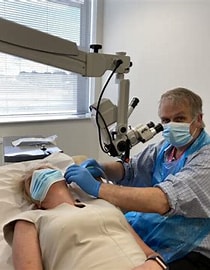
In the lead up to World Hearing Day, BIHIMA spoke to Dr Donal Collins, Clinical Director at BarlowCollins and a previous NHS GP for 27 years.
Dr Collins talked about his experience working in hearing health care, the key differences between NHS and private care and how he is striving to make access to hearing care more readily available for everyone.
BIHIMA: Donal, can you tell us about your
background and what brought you to where you are today with BarlowCollins?
Donal Collins (DC): I’m a retired GP, having spent 27 years with
the NHS. I had a special interest in Ear, Nose and Throat (ENT) cases for 22
years and in the latter half of my career I held senior leadership roles,
including running an ENT clinic in Fareham. In 2020, I set up my own enterprise
with my business partner, delivering an insulin sensitivity service (Type 2
diabetes remission work using food as medicine) and ear wax removal.
BIHIMA: How did the change from NHS to private
healthcare come about for you?
DC: Our ENT
clinic was incredibly successful – too successful, in the end. The service was
born out of ENT consultants needing a more efficient way to support patients
with hearing loss. Hospital waiting times were long and coupled with the fact
that patients would often miss their appointments (due to miscommunication or
external factors), it meant that the service was faltering. Queries about
delayed or missed appointments were unsurprisingly high and dealing with these
took time away from GPs and admin staff. After discussing the idea for six
months we finally landed on the outcome: there needed to be a service in the
community that was led by clinicians and responsive to patient needs.
Once
launched, we were able to cut down waiting times substantially. A routine wait
was around two weeks, but if a GP called us saying that a patient needed
immediate support, we we able to see them the next day.
Sadly, after
19 years we were shut down: our funding was cut due to financial pressures at
(what was then known as) the Clinical Commissioning Group with overspending,
and it was claimed that we were creating inequality in the area. While patients
in Fareham had a good experience with us, this meant that those living in
nearby Portsmouth had to wait longer, creating a variation in services. We were
improving waiting times for our local community but we created an unequal
service across the geography because other areas could not do the same. The NHS
does not like variation because it means not all patients have equal access to
the same services, so one way of creating an equitable service across the area
was to close our clinic. It was really sad at the time, and only once we’d
closed did we realise how valued the service was by patients and GPs alike.
BIHIMA: When working as a GP, what did you
find were the biggest barriers stopping patients from gaining adequate care for
their hearing?
DC: I think there
are several reasons, but ultimately it does start with waiting times. If a
patient is told that they’re going to have to wait weeks or months even for an
initial appointment, there’s a hefty chance that they’re not going to bother.
They think ‘well if I can’t be seen, what’s the point?’ They wait to see if it
will get better tomorrow, but then tomorrow never comes. As a result, they
assume that nothing can be done – they resign themselves to that (false!) fact.
There’s also
a lack of awareness and education out there about what can be done. And this doesn’t just reside in NHS care, we see this
in our practice as well. It is said that 25% of the adult population has ear wax that needs removing. At
BarlowCollins, we serve a radius of around 200,000 adults and this statistic
would suggest that 50,000 people in our area need ear wax removals. Even if you
halved that, it would be 25,000. The actual number of people that we are
supporting is around 2,500.
This crosses
over to people’s opinion of hearing instruments. They don’t have a particularly
positive press. Or, when they do, it’s from advertorials that typically
overpromise on their results. While a hearing instrument is unlikely to restore
your hearing back to how it was, it will absolutely improve it. But it takes
time to adapt, and this is something that needs to be shared on a wider scale.
It’s like driving a car – you won’t nail it the first time. And much like
driving that car, the younger you start, the easier it will be. If people wait
until they have lived with poor or damaged hearing for a long time, the
adjustment will be tougher. So there’s also something there about speaking to
younger patients at their level.
We need more
people to understand that yes, they can improve their hearing and yes, they
should take action to do something about it. It isn’t just about hearing things
better. Hearing loss has a huge impact on mental health and loneliness, majorly
impacting people’s quality and enjoyment of life. We see this sense of
loneliness in people with hearing loss firsthand. As a private clinic, we are
able to offer longer appointments. There are some patients who regularly return
to us before they actually need to and we believe it’s due to the time and
compassion they receive from another person; it’s evidence of the growing
number of cases of loneliness in the community.
BIHIMA:
Why did you decide to place a primary
focus on ear wax removal in your new practice?
DC: Around two
or three years ago, all GP practices stopped offering ear wax removals and it
is no longer provided by the NHS. Essentially, this came down to funding. As
practices got busier, decisions were made about what would (and wouldn’t) be
done based on resourcing. This continues to create huge pressures on secondary
care; unless you have a serious medical problem, you won’t be seen in relation
to your ear wax.
This change
brought with it a fair deal of animosity. People didn’t understand why
something they had always been able to get regularly before now came with a
price tag attached. But it’s swings and roundabouts, really. Yes, ear wax
removals come with an additional cost, but patients now have far more control
over their appointments. They’re longer, can be booked more last minute and you
can be pickier with the time.
I wanted ear
wax removal to be an important part of my practice because I know the
difference it can make to someone’s hearing. Hearing loss has many causes, but
the wonderful thing about it is that you can mostly do something to improve the
situation. It’s what makes my job so rewarding. Rather than walking with a
patient as they get worse – which is frequently the case in healthcare – you
get the joy and satisfaction of genuinely moving them to a better place, often
with relative ease.
BIHIMA: Within your current practice, have you
found any new issues stopping patients from receiving care?
DC: Finances, of
course. When I set up the company, it was one of our core values that we would
never refuse a patient care if they needed it. If they couldn’t afford it, they
could either pay what they could or we would do it for free.
For the first
two and a half years, this was barely used. In the past two to three weeks,
it’s been used around ten times. Clearly, the cost of living crisis is coming
into play here; and as we all know, this is only going to get worse. As long as
we don’t move into a loss, we will keep offering this to whoever needs it.
BIHIMA: Do you think there are any sections of
society missing out on the hearing treatment that they need?
DC: Absolutely.
It mirrors the whole system. Inequality within
poorer socioeconomic demographics, those living chaotic lifestyles,
homeless individuals, people with addictions – these are just some of the
groups that have less of an ability to either say they need help, or to have
the system listen to them (or both).
I think many
people are hoping for a top down solution, but they’ll be waiting a long time.
Instead, it needs to be bottom up. We need a deeper community understanding.
More awareness and perhaps more charities linking up with one another and with
local healthcare practitioners. Essentially, we need to embarrass those at the
top into some kind of action and accountability.
BIHIMA: Finally, what would you say is one of
the most forgotten benefits of hearing care?
DC: I suppose
that hearing care – whatever method you opt for – isn’t just for the patient,
it’s for everyone around them too. For example, if someone is wearing a hearing
instrument, then the people in their lives will recognise this and know that
conversation and communication will now be far easier. The benefits go wider
than the individual. It really is hearing care for everybody.