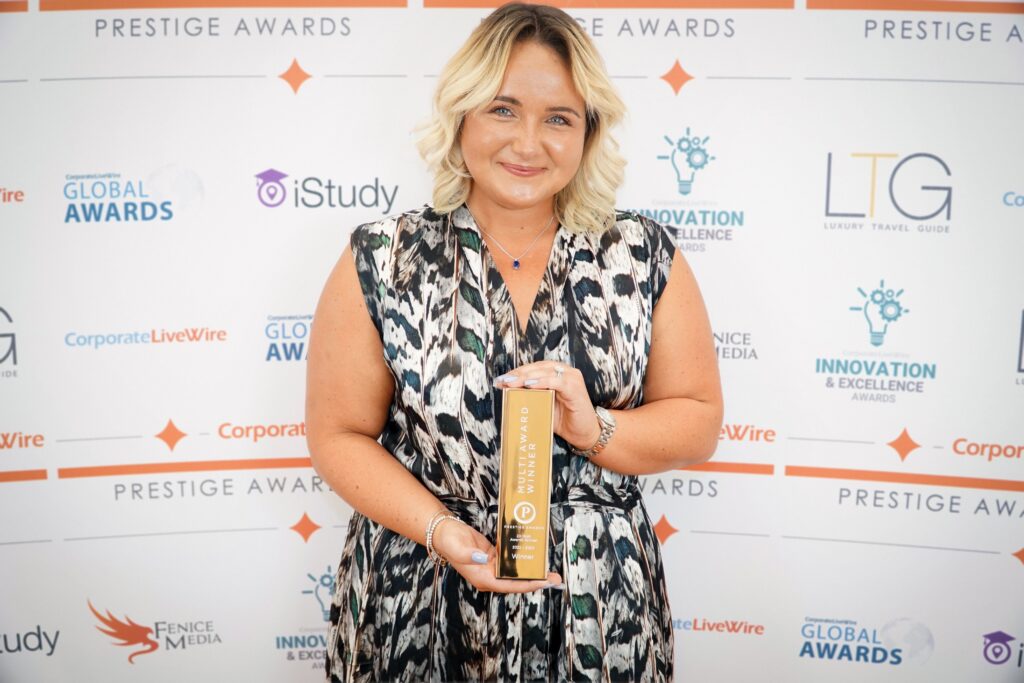
Despite stumbling into audiology by accident, Sarah-Jane Brown now owns her own audiology clinic in Oxfordshire. Read our interview where she shares her experiences of working for the NHS, in private clinics and now, her own company.
Sarah-Jane Brown started her audiology career in 2013 as an Assistant Audiologist in the NHS. Fast-forward 12 years, and she’s running an independent audiology clinic in Oxfordshire, SJB Hearing Company. She’s a passionate clinical audiologist focused on patient-centred care with like-minded professionals. We asked her to tell us about her career in audiology, as well as what she feels are some of the biggest challenges in the industry today.
Hi Sarah-Jane, it’s great to meet with you. To start things off, can you tell us about how you first got into audiology?
Believe it or not, I actually stumbled into it! I started my career in care as an auxiliary nurse on a neurological rehabilitation unit in Oxford. I was 17 at the time, and although I enjoyed what I was doing my personal circumstances shifted and I moved to High Wycombe. I knew I wanted to stay working in a care-centred role (and, ideally at the time, within the NHS), so I started hunting around for different opportunities. That’s when I spotted a job advertisement for an Assistant Audiologist. I didn’t really know what the role would entail, but I went for it anyway and got the job! And I’m so glad I did because I absolutely loved it.
I was then offered the chance to complete my foundation degree in Aston while still working, which I of course grabbed with both hands. It was a two year course which I qualified from in 2015. It was at this point I left the NHS and moved into private practice.
That’s interesting, what is it that made you choose to leave the NHS following your studies?
A few reasons – the department I worked in was changing beyond recognition. We had more patients and less time to support them, and I began to feel restricted. We were getting increasing numbers of younger patients who wanted hearing instruments with more technology; in particular, bluetooth. But I couldn’t provide them because of limitations on the devices we had available and it felt wrong.
The only way to change this seemed to be to move into commercial work, yet I was also terrified of the high street! A lot of the people on my course had worked in high street audiology and their stories of pressure and targets did not sit well with me. I wasn’t sure how private, independent audiology worked, but I started to look into it. That’s when a job came up in Banbury – where I was then living – for a small, private company. And as they say, the rest is history! It was my first private role and I stayed there until I opened up my own clinic in 2019.
What was it that made you want to take the leap into working for yourself?
I suppose it was initially when I realised how hard I worked for this company and how successful I was within my role, only to bring in money for the owner of the business without any real assistance from them. I also thought, I’ve got nothing to lose by giving it a try! If the business aspect of the clinic failed, I could also go back to another company. There was a huge urge to take a dive in and just try something new, and I have never regretted that decision.
I started small; I rented a room in a wellness clinic and purchased a wax machine and an audiometer. That was enough to kick things off! After two and a half years I moved into my own office and throughout the last three years things have really expanded. I now have a team working for me and truly couldn’t imagine ever working for someone again.
Sure, working for yourself is a risk. It has peaks and troughs, but the independent audiology industry does in general. Running my own business also means I can be creative with what I offer. I do a lot of work in the motorsports industry (thanks to some brilliant connections from my husband who has worked within it for over 12 years). We provide communication ear pieces and standard noise protection for F1 drivers and mechanics.
We’ve got some brilliant relationships in this space; our clients come to us because they trust that we’ll get the job done in the best way possible. We know how to make impressions that are deep enough to fit the ear canal while also accommodating helmets. There’s no room for error, and they often need a very quick turnaround time. It’s a fun addition to our day-to-day work and I don’t think I’d be delivering anything like that if I still worked for another clinic.
It all sounds incredibly rewarding. However, we know there are challenges in the industry. What do you feel are the biggest ones and what needs to change to better support patients?
That’s a tough question, but I think in many areas it’s an attitude problem. Far too many of the people I meet people in the industry are completely blinkered. They may have worked in audiology for 30 plus years and their approach is very much: ‘I’ve always done it this way, so why should I change now?’
I don’t believe there’s a lack of interest or support from manufacturers in developing new solutions, most of them are always happy to come and meet with you, to explain their technology and explore how they can meet people’s needs better. If we, as professionals, don’t take the opportunity to explore new technology and ways of working, it means the patient may not get the best service or device for them, simply because the audiologist is too set in their ways. We get some patients coming to us for a second opinion and sometimes basic information and services – such as bone conduction tests – are completely alien to them! It’s things they’ve never been offered before which should be standard practice. I know it won’t be everyone, but in some cases feels like there’s a slap dash approach being administered, with the bare minimum of care provided and nothing further.
NHS access is – unsurprisingly – another huge issue. It’s getting harder and harder for patients to be seen, with many on a 12 month plus waiting list. These can be patients with seriously debilitating hearing conditions; conditions which will only worsen the longer they wait and setting off a ripple effect on their processing ability as well. Whether we were already on the trajectory pre-COVID and COVID exacerbated it, I don’t know: what I do know is that the impact cannot be underestimated. It doesn’t help that it feels like we still face a divide between the NHS and private audiologists. I wish I knew why! We are all aiming for the same outcome, and surely if private audiologists can relieve some of the pressure from the NHS, our ability to work in tandem can only be a good thing?
The rollout of AQP support has also been a big challenge – both for the industry as a whole and for us as independent providers. My concern is that when you see NHS patients in a private clinics you are restricted to what devices you can offer within that NHS contract, but I know that some audiologists will try and upsell the patient to a higher performance model.
This type of practice crosses an ethical boundary for me and can lead to major distaste with the patients. After all, they’re part of an NHS pathway, only to then be sold hearing aids once they meet with the private healthcare provider. Unfortunately, some of the patients coming through AQP may not in a financial or demographic position to make that purchase, yet here they are being shown the big, bulky, brown hearing aids through the NHS in comparison to the sleek, tech-savvy ones through private manufacturers. Of course they’d prefer the modern alternative, but if they can’t take that option they’ll leave feeling disheartened. They’re then getting a lacklustre service as the appointments will not be as long and detailed as they might need, all of which comes together to give commercial audiology a bad name.
From our perspective, we then find we are firefighting many patients who come to see us. Which I fully understand. They’ve had bad experiences in the past, so why should we be any different? It’s therefore hugely important to me – and my team – to build that know, like and trust feeling with everyone who walks through our door.
We’re clinical (rather than commercial) audiologists. We understand people with complex needs and will spend at least an hour and forty minutes on a hearing test, exploring a wide range of hearing instruments before even suggesting a fitting. It’s for that reason that we have only a 2% return rate every year. Before we put anything in their ears, we know we’ve got the right hearing aid for them. Delivering that level of service is what the job is all about for me.
That’s something to be incredibly proud of! Thank you to Sarah-Jane for taking the time to share her journey with us. To find out more about SJB Hearing Company, you can visit their website.