Audiology services have changed significantly in Dorset over the past two years. We spoke to Clinical Lead Alan Bryant and Services Manager Helen Williams about what these changes have meant for patient care across the county.
Dorset audiology services have experienced some major – and exciting – changes in recent years. Historically, audiology had been delivered across the county by two services, with East Dorset facilitated by Dorset HealthCare and West Dorset under Dorset County Hospital. Following a service merger in 2023, there’s been the benefit of more funding and opportunities, culminating in the launch of a new base in Weymouth in February 2024; a new unit with state-of-the-art equipment, more advanced balance testing equipment and a bigger, more varied team.
We spoke to Alan Bryant, Adult Clinical Lead at Dorset HealthCare, and Helen Williams, Service Manager, about the impact of the hub and their experience working within the changing profession.
The new audiology suite in Weymouth sounds fantastic – can you tell us more about how it came about?
HW: Years ago, it was recognised that the two audiology services in Dorset were being run very differently. After a lot of discussion, the decision was made to move through a service merger, enabling us to learn from each other’s experiences, provide new skills and standardised patient experience across the locality. As the larger service, Dorset HealthCare led the service merger, and we were then lucky enough to be a part of the NHS England Community Diagnostic Centres programme, which is how the new Weymouth site came about.
As part of creating the new centre, we were able to expand our service and our workforce has completely changed – we’ve increased our team to include international recruits and apprentices, as well as upskilling and increasing the bands of many of our current audiologists so that they could enjoy a more complex scope to their work. We also have a dedicated administrative team and clinical leads with a full structure underneath them.
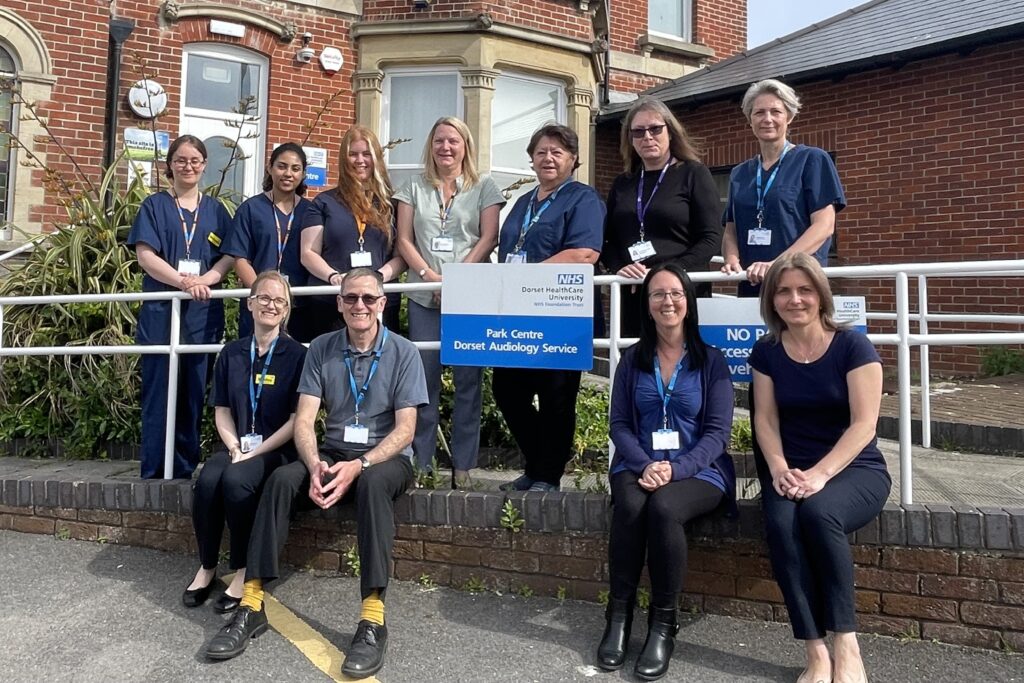
These changes have strengthened the service we can then provide to local people. We were also able to bring in new digital systems, which has improved our efficiency significantly.
Essentially, the funding gave us the chance to ask ourselves; what can be improved here? Already, as a result, we’ve been able to clear our backlog of requests and queries, reduce waiting list times and improve the patient experience. We feel very fortunate to have had that opportunity!
Absolutely – and what an opportunity it was! Alan, could you tell us what a typical day is like working in this new setup?
AB: What I can tell you is that there is no typical day! Adult hearing care has really shifted. Of course, working in the NHS I have always seen a wide range of patients. Even back when I started, we would see a mix of those with complex hearing loss, as well as complex additional needs, through to fairly routine appointments. What I tend to find now is that there is no such thing as a routine appointment – and a big part of that is because of the addition of shifting technology.
There is so much technology available, countless options, and therefore it is never a clear cut answer for what is going to be best for a patient. This is ultimately a positive thing, because it means we can work with a greater level of detail about each person’s needs and be far more focused on individual treatment options; we can really get to the depths of what that person needs to best suit their own personal goals and lifestyle.

I find that patient expectations are varied which I see as a good thing. People are coming to us much sooner, keen to take ownership of their health and understand what’s happening to them. They have questions and expectations which need to be managed in different ways. They are also more open to discussing their worries and the personal challenges of living with hearing loss, so we regularly have to use our counselling skills as audiologists.
It’s also crucial that we keep up with the evolving science behind emerging technology. Thankfully, that knowledge is now easier to access. In the past, you’d be reading lengthy papers, whereas now there are videos, summaries and external training courses. This makes life exciting, but it’s also tiring! After all, the more you know, the more you have to apply.
So, in answer to your question – a typical day in audiology is one where anything goes!
It sounds that way! What is it that first brought you to audiology?
AB: I graduated with a degree in Biology and initially took a placement in a lab – where I quickly realised I wanted to work with people! I looked into different fields, but what stuck out with audiology is that I would be able to work with people while being autonomous. Yes, you’re integrated into your team and with other healthcare providers, but mostly you manage your workload on your own. It was a huge attraction to me.
I then took my MSc in Audiology and qualified as a Clinical Scientist; from here I held various management roles at Royal Berkshire Hospital and was the Adult Clinical Lead for several years. However, I’m originally from Bournemouth and the beach was always going to call me back. I started working for Dorset HealthCare around two years ago and I’ve been very happy here since that day!
That’s great to hear. You’ve already touched on how your role has changed in that time; how else do you feel the profession has shifted?
AB: Alongside those technological advancements, there’s a considerable deal of change with regards guidance, best practice and support. This is great for patients, as it means we’re improving all the time. It does mean that you’ve frequently got new things to get your head around, but it’s the nature of the job and it keeps things interesting.
Since the pandemic, there’s also been a rise in networking and sharing of information opportunities. During COVID, everything moved online so, suddenly, we had an amazing opportunity to connect with people we normally wouldn’t be able to. As an industry, we’ve kept that going. It’s really exciting as we are able to share knowledge across trusts, audiology departments, local networks and beyond.
HW: I’d also say that in the last year and a half, as a profession our health care scientists and audiologists are becoming far more recognised across England. This hasn’t necessarily been the case up until now, but NHS England is committed to raising the profile of our work and the overall standards. There’s a lot of exciting progress happening for the future of health care science and audiology.
We agree, and it’s brilliant to witness. What would you like to see next for audiology?
AB: We always want to see quicker uptake and implementation for hearing; improvements in technology will help this. But, we also want to ensure that clinical quality is always maintained in tandem.
Personally, I’d love to see if there are ways that we can better support patients later in life struggling with their hearing needs in care homes. It’s such a complex area, and there’s still a substantial gap here. We must find more ways to help those who can no longer help themselves in the same way.
HW: We’d also like to see more collaborations between education and workforce. We’re grateful to now support apprenticeships across Dorset, but this is just one element. We know that bringing people into audiology and then retaining them is a challenge, so we need a multi-pronged approach to welcome more new starters into the workforce, rather than putting all of our eggs in one basket. Part of this should include highlighting the benefits of working for the NHS, because for an audiologist, there’s nowhere that will provide such a rich array of experience.
This leads us perfectly to our final question – what would you say to new starters coming into audiology?
AB: My biggest piece of advice would be keep your enthusiasm up and maintain your excitement for the role by continuously learning. There is always new knowledge to require, and never forget that you are not only a scientist but a counsellor, so there will forever be a new piece of research, or a different approach, or evolving technology to keep you on your toes – things that will, ultimately, ensure you are also doing the very best for your patient. And isn’t that why we come into the profession in the first place?
On that note, we would like to extend a huge thank you to both Alan and Helen – it was a pleasure to speak with you both. To find out more about Dorset’s audiology services, you can visit their website.
Lorem ipsum dolor sit amet, consectetur adipiscing elit. Ut elit tellus, luctus nec ullamcorper mattis, pulvinar dapibus leo.