From sensor-augmented AI sound processing to Audible Contrast Threshold testing, Oticon is pioneering a new era of precision, personalised hearing aid technology.
Thomas Behrens has been with Oticon for over 26 years – a career that has taken him from early research roles through to his current position as Global Head of Audiology and Research. Few people have witnessed or helped drive the level of change he has.
“The leap has been dramatic,” he explains. “I started during the digital transition and back then, digital sound quality took time to catch up with analogue. Today, thanks to years of refinement, we’re seeing a new era: one where artificial intelligence and precision diagnostics are transforming what hearing aids can do.”
This new era isn’t just about better sound; it’s about better understanding. Of users, their worlds and experiences and how hearing works in real-life situations.

What AI in hearing instruments really means
There’s a lot of excitement (and a fair bit of anxiety) about AI in healthcare. For some, it can sound futuristic or even intrusive. But for hearing devices, AI isn’t about replacing human expertise; it’s a tool to enhance it. A way to help people hear more naturally, more clearly, and more comfortably in the real world, especially in noisy, complex listening environments.
“Hearing aids now use AI to recognise sound patterns, just like a doctor might use AI to analyse medical images,” Behrens says. “We train them with millions of sound samples – inputting different clips of speech, background noise, cafés, crowded rooms – so they learn how to enhance what matters and filter out what doesn’t.”
At the heart of this process are spectrograms: detailed maps that show how sound energy is spread across different frequencies over time. These allow the AI to identify the subtle signatures of speech and the varying bursts of energy that come from the use of vowels and consonants, comparing how those individual sounds are affected when background noise is present.
In a quiet room, the sound pattern of someone speaking is relatively easy to detect. But in a busy restaurant or echoey hall, the signature becomes muddled. The AI’s job is to ‘clean up’ that sound: to make speech stand out again, even when it’s masked by clinking cutlery or overlapping conversations.
“It’s all about helping the brain differentiate between speech and noise more easily,” Thomas tells us. “We’re not amplifying everything. We’re enhancing speech, and dampening irrelevant sound, so users can tune into the sounds they actually want to hear.”
This means users don’t just hear more, they understand more. And that makes a real difference in everyday life: from following a chat with friends to picking up on important details at work or in school. With AI, hearing aids can be more responsive, more accurate, and more supportive than ever before.
Smarter sensing for real-world listening
But recognising sound is just part of the puzzle. What makes Oticon’s latest hearing instruments even more impressive is how they adapt to the user’s behaviour.
“Our most modern devices don’t just listen, they sense. Acoustic sensors analyse what’s coming in, while motion sensors detect what the person
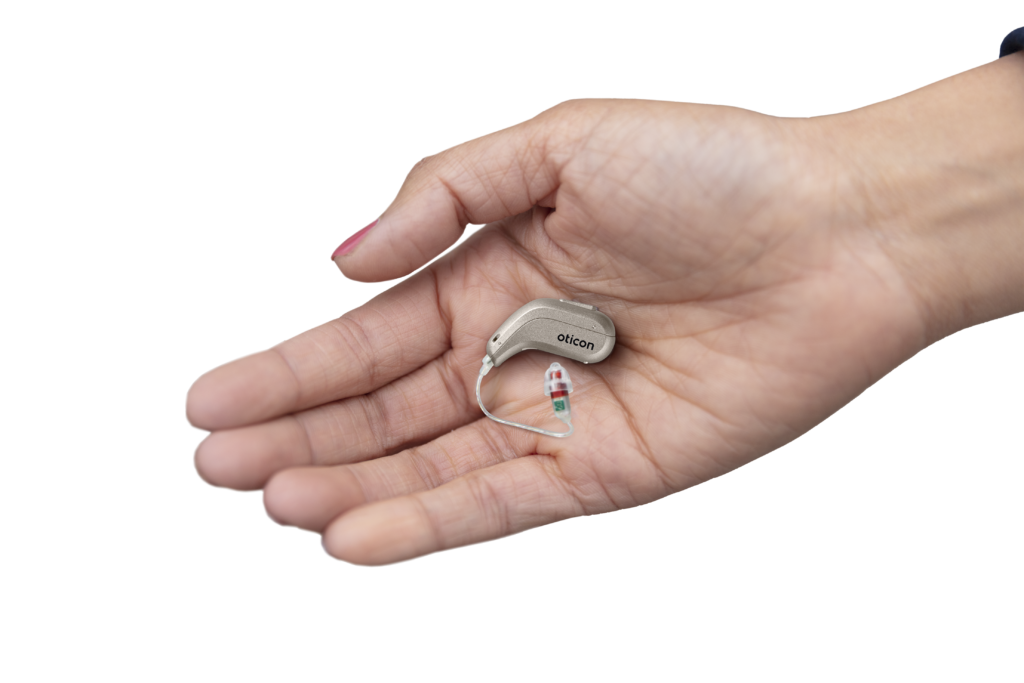
is actually doing. For example, are they standing still, walking, or turning their head?” Thomas explains. “This tells us if they’re in a quiet one-to-one situation, a busy group conversation, or taking a walk outside with someone. And the hearing instrument subtly adjusts how it processes sound to match.”
Importantly, this doesn’t mean AI is spying or recording conversations. “The technology can’t think for itself, so it doesn’t understand words or content. It simply recognises the presence of speech and the characteristics of the environment.”
From generic fitting to precision prescription
One of the biggest challenges in audiology is that the traditional pure tone audiogram tells us very little about how someone actually experiences sound. It doesn’t capture how well they can pick out speech in noise, or how the brain is handling incoming information.
That’s why Oticon is pioneering a new diagnostic tool: Audible Contrast Threshold (ACT). This cutting-edge, language-independent measure quantifies a person’s ability to distinguish speech from background noise.
“Two people can have the same hearing loss on paper but experience it completely differently in real life. Some cope well with noisy environments. Others find it overwhelmingly difficult. ACT helps us pinpoint that difference.”
Once this data is captured, it’s used to precisely tailor how the person’s hearing instrument functions, from noise handling to frequency shaping, ensuring that support is truly individualised.
Of course, not everyone has the same access to hearing care and Thomas acknowledges that time and resource constraints, especially in public healthcare systems like the NHS, can limit how much personalisation is possible in the clinic.
“We’re very aware that many clinicians don’t have hours to spend tweaking every device,” he says. “So we design our default settings to work for as many people as possible, based on extensive testing. But the real power comes when we can adjust the device to the person’s unique profile.”
That’s where precision diagnostics and sensor-augmented AI come together; enabling clinicians to offer personalised care, even within limited timeframes. By combining smarter default settings with data-driven insight into each individual’s real-world listening challenges, hearing instruments can be finely tuned without requiring hours of manual adjustment. It means even in busy clinics or public healthcare settings, people still receive technology that adapts to them, not the other way around.
The future of AI in hearing care
For Oticon, this is just the beginning. Thomas hints at a broader role for AI across the entire hearing aid ecosystem, “Right now, we’re using AI in one area of functionality. But there’s so much potential in how hearing aids can understand environments, manage user preferences, and respond in real time. The more precise our diagnostics become, the more accurately we can shape support for each user.”
At its heart, this isn’t just about technology. It’s about human connection. Being able to hear your grandchild at a family gathering. Chatting with a friend in a noisy café. Staying present and engaged in the world around you.
As a valued member of BIHIMA, Oticon’s pioneering work reflects the very ethos our organisation champions: driving forward innovation that puts the user first. By combining advanced AI with personalised diagnostics, they’re not just improving hearing aids – they’re reshaping the future of hearing healthcare. At BIHIMA, we continue to support and showcase the manufacturers leading this charge, ensuring that cutting-edge technology translates into real-world benefits for people with hearing loss across the UK and beyond.
To find out more about Oticon’s development, visit Oticon hearing aids | Life-changing hearing technology