With the launch of the Infinio Sphere platform, Phonak has introduced a new AI-driven approach to hearing in complex, real-world environments. We spoke with Ian Mortimer, Head of Audiology at Sonova UK, to understand how “Spheric Speech Clarity” works and what it could mean for hearing instrument users.
Ian Mortimer didn’t set out to become a technology specialist, but it happened naturally. After studying Audiology at Aston University, he worked in both the NHS and private practice before joining Sonova – the group behind Phonak, Unitron, and several other well-known brands.
“I’ve always been a science and tech nerd,” he admits. “Audiology was the perfect blend; real, personal healthcare supported by incredible engineering.”
At Sonova, Ian now plays a key role in preparing upcoming innovations for the market: “I’m usually working on things I’m not allowed to talk about yet,” he laughs, “but once the launch arrives, that’s when the wider audiology world gets to see what we’ve been building.”
One of those recent launches is the new Infinio Sphere platform and the Audeo Infinio Sphere product, which houses Phonak’s most advanced AI system to date and introduces a feature Ian believes could be a turning point for hearing aid users: Spheric Speech Clarity.

The real challenge of everyday communication.
For many people, hearing instruments perform well in controlled environments, but struggle where life is actually lived – in noise.
“There’s no blanket answer in hearing care,” Ian explains. “Every individual’s listening world is different. But the ‘cocktail-party problem’ is something we hear about again and again.”
He describes that moment many people recognise: a dinner or social gathering where following conversation becomes impossible. For some, this is the experience that finally pushes them to seek help.
But equally significant, Ian says, are the everyday challenges; the ones people rarely talk about.
“You can be sitting right next to your partner at home and hear fine. But the moment there’s distance, or a TV on, or someone speaking from another room, you get that constant ‘sorry?’ ‘pardon?’ The fatigue of not hearing properly in ordinary situations can be more impactful than people realise.”
Introducing Spheric Speech Clarity: hearing speech from every direction.
Traditional hearing instruments use a directional microphone system – usually two microphones, front and back – to estimate where speech is coming from and focus on it. This works well when a speaker is directly ahead, but not when sound comes from other angles.
Spheric Speech Clarity approaches the problem differently. Instead of simply boosting the front and lowering the back, Spheric Speech Clarity uses a deep neural-network AI system to analyse sound in a full 360° sphere around the listener.
In simple terms, Spheric Speech Clarity tries to identify actual speech (wherever it’s coming from) and separate it from background noise.
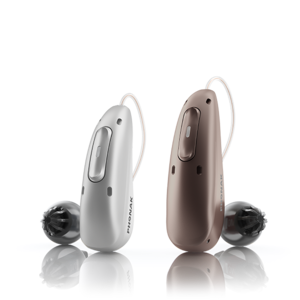
It is constantly identifying, prioritising and enhancing speech from multiple directions, while reducing everything else. For the user, that means clearer voices, less strain, and a more natural sense of space.
“The first time I heard it working in real time,” Ian says, “I realised this was different from anything I’d heard in a hearing instrument before. It’s able to separate live speech from noise on the go in a way that feels almost effortless.”
How AI makes it happen (without overwhelming the user).
AI in hearing instruments can be intimidating. Ian is keen to emphasise that users don’t need to understand the technical details to benefit.
“There are different flavours of AI,” he explains. “We use machine learning and deep neural networks. The device analyses your acoustic environment hundreds of times per second, and automatically chooses the best listening setting out of over 200 possible combinations.”
The big aim, he says, is good hearing that happens automatically. No fiddling with settings, no jumping between modes: the experience adapts on its own.
“We trained the system using huge real-world datasets, teaching it how people experience environments like offices, streets, restaurants. Then we let the neural network learn the patterns itself. The progress in the last five years alone has been incredible.”
Feedback so far has been overwhelmingly positive.
“I’ve done thousands of Spheric Speech Clarity demonstrations for hearing care professionals across the country,” Ian says. “We bombard them with café noise, clatter, voices from every direction. Then I switch Spheric Speech Clarity on. The change is instant. You can see their body language shift. They relax. They can hear me in a normal voice even though all that noise is still happening.”
Hearing instrument wearers are reporting similar moments: clarity in restaurants, effortless conversation at gatherings, less listening fatigue throughout the day.
“No product will suit absolutely everyone,” Ian adds, “but this has been our most successful platform launch ever. People want to talk about it – and that tells you a lot.”
Looking ahead at the next 5 years of hearing technology
What excites Ian most about the future is both performance and simplicity.
“The cocktail-party problem has been a long-standing challenge. Spheric Speech Clarity is doing a great job there, and it will continue to improve. But equally important is making hearing technology blend seamlessly into life.”
That means fewer barriers:
- less maintenance
- easier Bluetooth and connectivity
- more intuitive charging and handling
- automation that genuinely reduces cognitive load
“You can have fantastic technology,” Ian says, “but if it’s difficult for your average user to live with, what’s the point? Ease of use and convenience are crucial.”
A more natural, confident way to hear.
AI in hearing aids doesn’t have to feel futuristic or technical. For many users, the benefit of Spheric Speech Clarity may simply feel like being part of the conversation again: hearing speech clearly even when life is busy, unpredictable and noisy.
To learn more about this technology and the full Sonova range, head over to their website.